
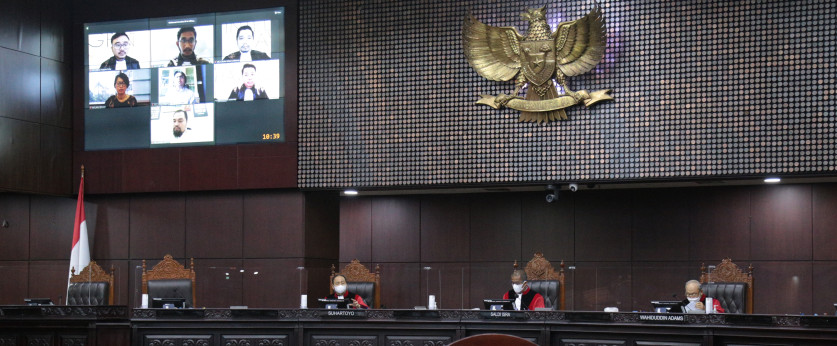
RAP & Co represented four insolvency practitioners acting as curators and PKPU administrators before the Constitutional Court in a judicial review of Articles 235(1) and 293(1) of Law No. 37 of 2004 concerning Bankruptcy and Suspension of Debt Payment Obligations (PKPU). The petition was registered as Case No. 38/PUU-XX/2022.
The petition followed Constitutional Court Decision No. 23/PUU-XIX/2021, which opened the possibility of cassation against certain PKPU decisions. The decision raised a practical question for insolvency practitioners: what happens to acts performed by PKPU administrators if the PKPU decision under which they were appointed is later overturned on cassation?
Prior to Decision No. 23/PUU-XIX/2021, Articles 235(1) and 293(1) of the Bankruptcy and PKPU Law excluded legal remedies against PKPU decisions. The Constitutional Court subsequently declared the provisions conditionally unconstitutional and allowed cassation in certain PKPU matters.
The Petitioners argued that this development created a potential conflict in the administration of PKPU proceedings. PKPU administrators may continue to perform their duties while a PKPU decision remains in force. However, the law did not expressly address the status of their acts, remuneration or costs if the underlying PKPU decision is subsequently overturned on cassation.
RAP & Co acted as counsel for the Petitioners. As recorded in the Constitutional Court’s decision, the Petitioners were represented by Rendy Anggara Putra, S.H., Taufan Wizart Lufthansa, S.H., Imanuddin Arrahim, S.H., Sigit Egi Dwitama, S.H., Muchammad Rizki Fauzan, S.H., and Gilang Prabowo, S.H., M.H., advocates and legal consultants at RAP & Co.
The Petitioners sought to address this uncertainty by asking the Constitutional Court to expand the interpretation of Articles 235(1) and 293(1). In particular, they proposed that the consequences of cassation in PKPU proceedings be governed mutatis mutandis by Articles 16 and 17 of the Bankruptcy and PKPU Law.
The proposed interpretation drew from the legal position of curators in bankruptcy proceedings. Under Article 16, a curator may perform their duties from the date a bankruptcy declaration is pronounced even where cassation or judicial review is pursued. Acts performed before the curator receives notice of an annulment remain valid and binding on the debtor.
The Petitioners argued that PKPU administrators should receive similar protection. This would provide greater legal certainty for administrators who act while a PKPU decision remains effective and help address the potential consequences of a subsequent cassation decision.
On 31 August 2022, the Constitutional Court rejected the petition in its entirety. The Court acknowledged that the consequences of cassation in PKPU matters had not yet been regulated. It also called on the Supreme Court to complete the regulation of cassation procedures against PKPU decisions as soon as possible.
The Court further noted that any such regulation should take into account and protect the rights attached to appointed PKPU administrators. At the same time, the Court held that the absence of such regulation did not render the challenged provisions unconstitutional.
The decision highlights an ongoing issue in Indonesian insolvency practice following the recognition of cassation against certain PKPU decisions. For PKPU administrators, creditors and debtors, the treatment of acts performed during the PKPU process may become particularly important where a subsequent cassation decision changes the status of the underlying PKPU decision.
The matter reflects RAP & Co’s involvement in insolvency and constitutional litigation and its representation of insolvency practitioners in addressing legal certainty arising from the development of PKPU remedies.